
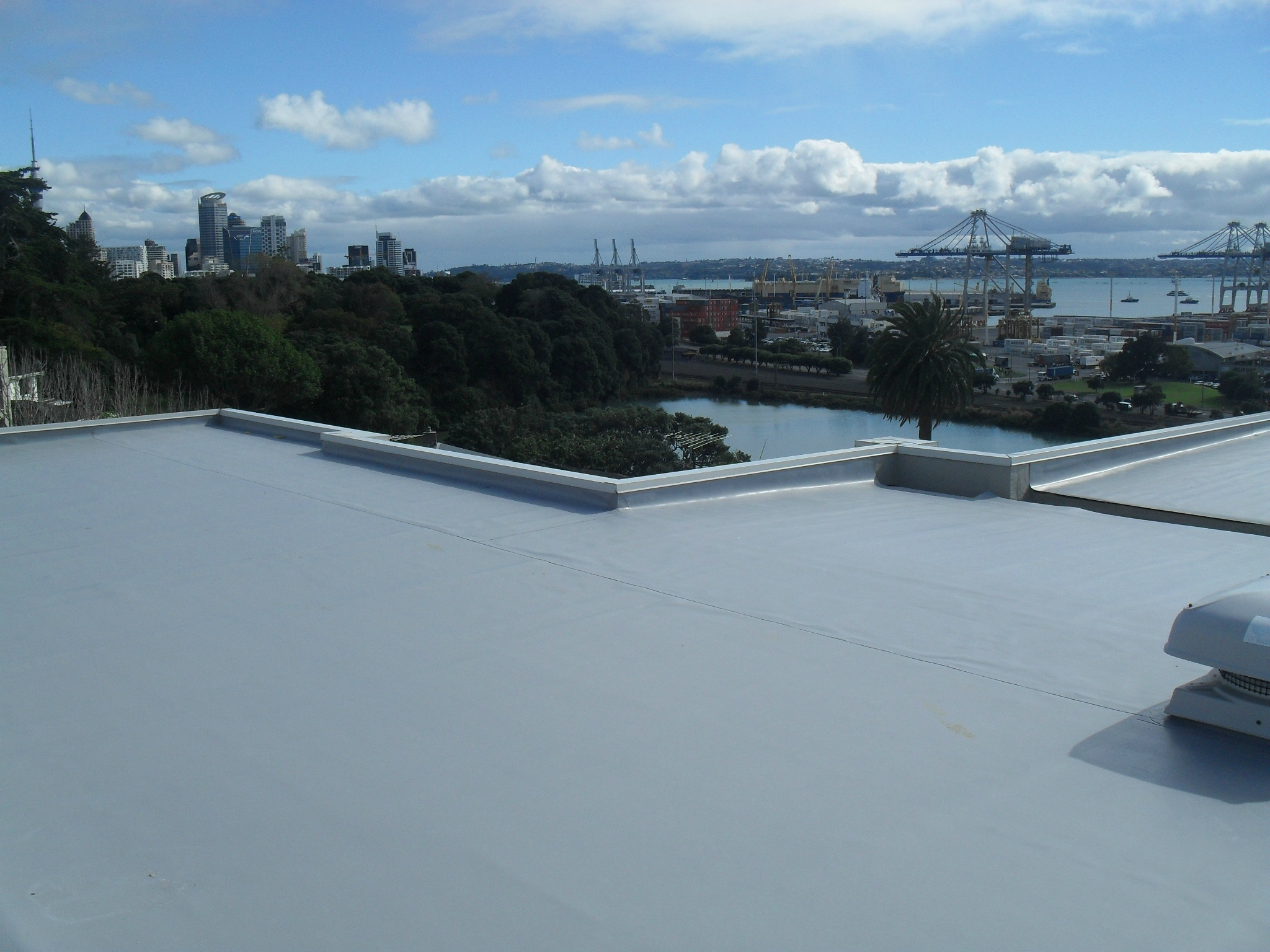
A roof that can't shut the building down
An airport doesn't close, and that single fact reshapes every roofing decision before a crew ever sets foot on the deck. Southwest Florida International Airport, RSW off Daniels Parkway near the Treeline Avenue corridor, moves millions of passengers a year for Lee County and the Fort Myers and Cape Coral metro and runs around the clock, every day of the year. There is no overnight when the terminal empties out and the work can happen unwatched. Every access point, every material lift, every crew deployment has to be coordinated with the airport's facilities department, its FAA Part 139 safety program, and in places the TSA's security requirements. We build that coordination into the scope before the contract is signed, not after we mobilize and discover a lift can't stage where we assumed.
The roof areas themselves are large, low-slope, and unforgiving. A terminal can run acres of nearly flat membrane, which puts drainage design at the center of the job and pushes the tolerance for ponding water close to zero — on a roof that big, a slight low spot becomes a standing pond that works at the membrane for years. RSW's ongoing terminal and parking expansion, layered on top of the hurricane-wind requirements every coastal Florida structure has to meet, makes airport roofing one of the more specification-intensive segments in Southwest Florida.
Wind and jet blast load the roof harder than a normal building
Aviation roofs carry exposures that a comparable logistics building never sees. Airside roof areas catch jet-blast and the open, unobstructed wind that comes with a wide-open airfield, so membrane adhesion and ballast or attachment have to be specified beyond standard commercial values. Pair that with the hurricane uplift loads coastal code already demands and the attachment design becomes the heart of the specification rather than a line item. We size the system to the wind environment the building actually lives in, not to a generic low-slope assumption.
Terminal HVAC is denser and heavier than standard
The mechanical load on a passenger terminal is far heavier than ordinary commercial. Conditioning a high-occupancy public space means more rooftop units, larger and more frequent curbed penetrations, and a longer list of flashing details to maintain. Our pre-project survey documents every penetration, curb height, and mechanical clearance before the work plan is built, and the flashing for oversized equipment curbs and complex through-penetrations is detailed individually. Standard patterns don't belong on a terminal roof.
The campus is more than the terminal
An airport is a campus of buildings, and the coordination requirement follows you across all of it. Cargo facilities, rental-car centers, FBO hangars, aircraft-maintenance buildings, and on-campus hotels each bring their own roofing challenges, but the badging and security access never go away just because you've stepped off the terminal roof. Crews understand that authorization at any point on an airport campus is non-negotiable and planned for in advance, never discovered onsite.
Secondary fields and general aviation
RSW is not the only aviation roofing demand in this market. Page Field, FMY, sits inside Fort Myers as the general-aviation reliever, and Punta Gorda Airport, PGD, serves the area from up the coast. General-aviation work carries lighter security than the commercial terminal but often a more demanding building: high-bay hangars are long-span, clear-span structures whose wide roofs generate serious wind uplift and need specific fastening patterns and seam geometry to hold. For new high-bay structures and hangars a standing-seam metal system is often the right call; for terminal re-roofs a TPO or PVC single-ply over tapered insulation usually wins, with the taper engineered to drive water off that vast flat plane.
Airside discipline and closeout
Airside work — anything near active aprons, gates, or taxiways — runs on a higher level of pre-planning and crew credentialing, scheduled into approved windows and coordinated through the FAA's NOTAM process where required. We don't put a crew member on an airside roof without confirmed authorization, and we don't learn the airport's coordination rules on the owner's project. The work walks with the facilities engineer first, gets a phased plan approved by operations, and finishes with the permit, inspection, warranty, and roof-zone documentation the airport's asset file needs.
Airport & Aviation Roofing Questions
How do you schedule work at an airport that never closes, like RSW?
We work with the airport facilities department and the FAA Part 139 coordinator to build a phased plan approved by operations. Material deliveries, crane lifts, and any work near airside areas are scheduled into approved windows and coordinated through the FAA NOTAM process when required. The coordination is a standard part of our setup, not an exception we figure out mid-project.
What roof systems suit a large-span terminal roof?
Most terminal re-roofing uses a TPO or PVC single-ply over a tapered insulation system engineered to improve drainage and eliminate ponding on the vast flat plane. New high-bay aviation structures and hangars are often specified in standing-seam metal. The choice depends on the existing deck, load capacity, and operational constraints, developed after walking the roof with the facilities engineer.
How do you handle the density of HVAC and penetrations on a terminal?
Terminal HVAC density is well above standard commercial. Our pre-project survey documents every penetration, curb height, and mechanical clearance before the work plan is built, and flashing for oversized curbs and complex through-penetrations is engineered individually rather than using standard patterns.
Can you work on airside structures near active aprons and runways?
Yes, with appropriate badging and full coordination with airfield operations. Airside work requires a higher level of pre-planning and crew credentialing, which we factor into the bid timeline. We do not mobilize crew without confirmed airside authorization — it's a baseline requirement we enforce.
Do you handle hangar roofing for FBOs and general aviation?
Yes. General-aviation hangar roofing, from a single-bay private hangar to a multi-unit FBO complex, is a regular part of our work in the Fort Myers area. High-bay hangars on wide-flange steel or pre-engineered systems have specific uplift and thermal-movement characteristics, and we specify and install for those structures.