The roof over a regulated lab is a controlled environment
On most commercial buildings a roof leak is an inconvenience. Over a compounding pharmacy, a clinical lab, or a biotech research suite, a single drop of water in the wrong place can spoil a batch, corrupt an assay, or shut down an ISO-classified room until it can be requalified and certified again. We approach pharmaceutical and laboratory roofing in Fort Myers as work that happens inside a controlled environment, not just on top of one. Every decision about sequencing, materials, and documentation is made with the rooms beneath the deck in mind.
This kind of work has a real home here. Lee County has spent years pushing to grow its life-science and medical base, led by the Lee Health system and the medical clusters that have built up around HealthPark and the Daniels Parkway and Gateway corridors, with lab and research space filling in alongside the office parks off Metro Parkway and near Florida Gulf Coast University. These tenants carry FDA facility expectations, sometimes DEA security requirements, and a closeout paper trail that a typical strip-center roofer is not set up to satisfy.
Access and credentialing come first
A roofing crew that shows up to a regulated pharmaceutical site without pre-cleared credentials burns a mobilization day and can trigger a compliance event. We handle access and badging during pre-construction, usually starting two to three weeks ahead of the start date so the full crew is cleared before anyone climbs a ladder. Escort rules, restricted zones over controlled-substance areas, and gowning or staging requirements get written into the coordination plan up front, not discovered on day one.
Cleanroom HVAC and the pressure you cannot break
Lab and pharma roofs are dense with mechanical equipment, and much of it is doing delicate work. Dedicated HVAC units hold cleanroom pressure cascades. Fume-hood and process exhaust carry corrosive vapor streams. Biosafety stacks run through HEPA filtration. Building-automation conduit threads between all of it. Any flashing work near a cleanroom supply or exhaust connection has to respect the pressure differentials those rooms depend on. We coordinate penetration work with your facility MEP team, target planned HVAC maintenance windows, and verify pressure recovery and cleanliness after we close up so the certified rooms below stay certified.
Corrosive exhaust and the right membrane
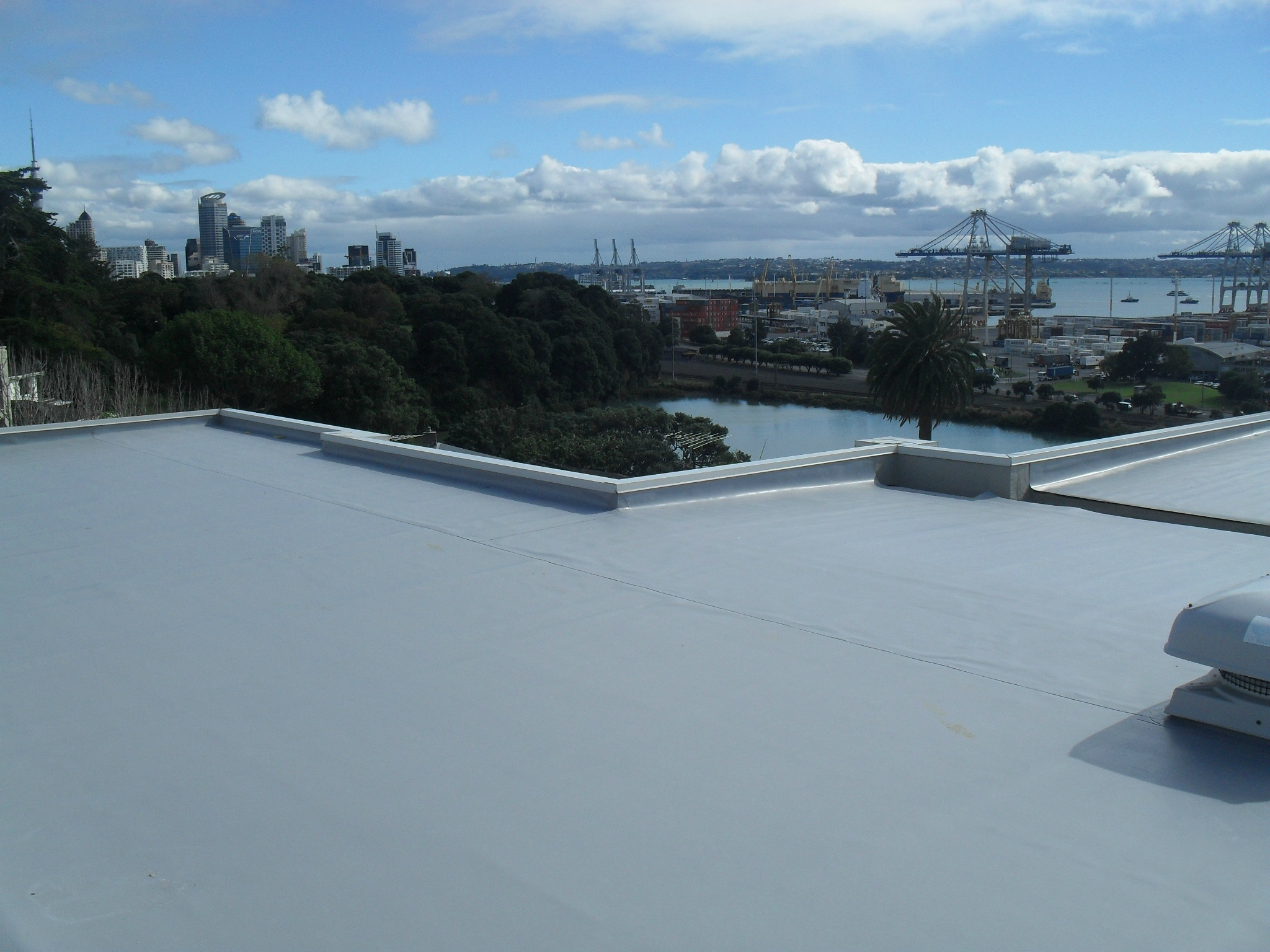
Solvent and acid vapors that leave a lab don't always disperse cleanly into the air. In humid Gulf Coast conditions they can condense on the outside of an exhaust stack and drip back onto the surrounding membrane, etching localized chemical burns that no standard weather warranty will cover. We identify the actual exhaust chemistry with your MEP team and specify accordingly: typically a 60-mil PVC membrane, the most chemically tolerant single-ply option, with reinforced detailing in the rings around solvent and acid stacks. Standard TPO has no business sitting downwind of a fume exhaust, and we won't put it there.
Vibration isolation and rooftop equipment platforms
Sensitive instruments care about more than water. Mass spectrometers, electron microscopes, and precision balances are sensitive to vibration, and rooftop chillers, air handlers, and exhaust fans are a major source of it. When we set new curbs or rework equipment supports, we coordinate with your facility engineer on vibration-isolation requirements so the roof work does not introduce a new path for mechanical noise into the labs below. We also build out walkway pads and equipment platforms that keep the steady stream of HVAC and instrument-service technicians off the membrane field, because on a lab roof the foot traffic from maintenance and calibration crews is constant and a single punctured seam over the wrong room is a problem out of all proportion to its size.
High-value buildings need a different risk posture
- Zero-tolerance leak philosophy. We dry in each work area daily and never leave sensitive equipment exposed to an open deck overnight, especially during the summer storm season.
- Storm-rated detailing. After Hurricane Ian, current wind requirements on this coast are non-negotiable. We document edge metal, curbs, and membrane attachment to match.
- Audit-ready documentation. Daily reports, material submittals, system certifications where required, and warranty registration are delivered in a package your quality team can hand to an inspector.
The buildings on these campuses are among the most valuable in the region's commercial inventory, and the cost of a roofing-driven contamination event dwarfs the cost of the roof itself. Our pre-mobilization coordination, daily documentation, and closeout package are built to satisfy both your operations team and the quality auditors who review their work.
Pharmaceutical & Laboratory Roofing Questions
How do you handle FDA and security access requirements?
We start contractor credentialing, background checks, and any DEA or facility security clearance during pre-construction, typically two to three weeks before mobilization, so the full crew is cleared before the start date. Escort and access restrictions are documented in the coordination plan rather than improvised on site.
What membrane do you use near corrosive exhaust stacks?
60-mil PVC is our default for lab and pharma roofs because it is the most chemical-resistant single-ply membrane available. Around corrosive stacks we confirm the exhaust chemistry, check it against the manufacturer's resistance guide, and reinforce the detail in those zones. We do not specify standard TPO near solvent or acid vapor.
How do you protect cleanroom pressure during the work?
We schedule penetration flashing near cleanroom HVAC connections during planned maintenance windows, coordinate with your MEP team throughout, and verify pressure-differential recovery and cleanliness after the work so no dust or debris enters the air paths above the room.
Do you work on biotech and university research labs?
Yes. Research buildings bring similar access and coordination needs, often with multi-tenant lab suites running independent HVAC and biosafety stacks for different programs. We are comfortable coordinating with Environmental Health and Safety offices and biosafety committees on those projects in the Fort Myers area.
What closeout documentation do you provide?
A full package: contractor qualification records, site safety plan, reviewed scope and material submittals, daily work reports, manufacturer installation documentation, FM Global or UL system certification where required, and warranty registration, all formatted to move through your quality management system.